










Selection of the right electricity meter manufacturer is an important decision for utility companies, infrastructure developers, contractors, and energy management organisations. Electricity meters are not only used for measuring consumption, but they also play a vital role in billing accuracy, data collection, grid management, and long-term operational efficiency. A reliable manufacturer will help to ensure meters perform consistently under different operating conditions, which will support utility requirements.
Even though electricity metering and water metering are different applications, many modern utility projects are adopting similar principles of smart measurements, remote monitoring, data communication, and leak or loss detection. Technologies developed around smart water metering and other connected metering systems will provide useful understanding when there is a change for manufacturers in modern utility projects.
1. Understand Your Project Requirements
Before the selection of the manufacturer is done, there is a clear definition of the requirements of your project. Different types of projects will require different types of meters, communication technologies, the right classes, installation methods and data management capabilities.
Let us consider factors like:
- Type of electricity supply and network
- Single-phase or three-phase metering
- Required measurement accuracy
- Prepaid or postpaid operation
- Remote meter reading requirements
- Communication protocols
- Environmental and operating conditions
- Number of meters required
- Integration with existing utility software
Having the clear specifications will make it easier to compare manufacturers and will identify suppliers capable of metering your manufacturers and will identify suppliers capable of metering your technical requirements.
2. Look for Smart Metering Capabilities
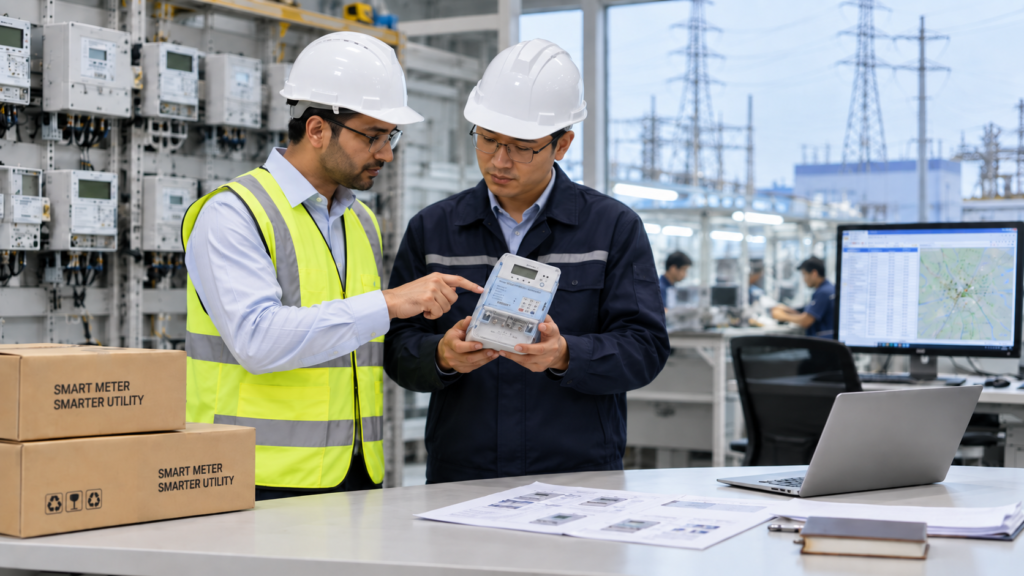
Modern utility projects have increased the move away from traditional meters towards connected and intelligent metering systems. A good manufacturer will have experience with smart metering technologies, communication systems, remote monitoring and data management.
The same digital transformation will be seen in smart water meter technology, where connected meters will allow us to collect consumption information remotely and analyze the use of patterns. Electricity meters have similar capabilities, which will help to use improved billing, identify unusual consumption, and make better operational decisions.
When there is a requirement to evaluate the manufacturer, ask if its meters support technologies like wireless communication, remote metering, automated data collection and integration with advanced metering infrastructure.
3. Check Product Accuracy and Reliability
Accuracy is one of the important factors when you select the electricity meter manufacturer. Even small measurement errors will create significant financial differences when there are thousands of meters getting installed in different utility networks.
Do ask the manufacturers about their testing procedures, accuracy levels, quality control systems and product certifications. Reliable meters will maintain accurate measurements over long periods and under verified electrical and environmental conditions.
The manufacturer with a strong quality assurance process is more likely to give a consistent product for large-scale utility projects.
4. Evaluate Communication and Data Features
Smart utility projects will require more than accurate measurements. They will also require efficient communication between mentors and central management systems. Based on the project, communication will use technologies like RF, cellular networks, NB-IoT, LoRaWAN, PLC, or different communication methods. The right choice is based on the network availability, project location, installation density, and data requirements.
For comparison, water management with smart meters often takes advantage of remote data transmission in order to provide utilities with consumption information as soon as possible. Electricity metering projects can greatly benefit from the same approach, which allows for automated meter reading and centralised monitoring.
5. Consider Data Security
Connected electricity meters are able to handle valuable consumption and customer data, which makes cybersecurity an important consideration; the manufacturer should have appropriate security measures for communication, authentication, firmware updates and data protection;
Ask potential suppliers how their meters protect transmitted information and how security is maintained throughout the product life cycle. Strong security features can reduce the risk of unauthorised access and help utilities to maintain reliable operations.
6. Examine Customisation Options
The technical and commercial needs of a utility project can be numerous and varied. As such, it is important to identify a manufacturer that can offer a high degree of customisation.
This may take the form of communication modules, meter displays, software integrations, enclosure design, firmware functions and communication protocols. A manufacturer with strong engineering and research and development capabilities will be better equipped to customise its products and solutions to meet the needs of a project.
Meanwhile, experience across a broad range of smart metering applications, including smart water metering, can also be an indicator of a company’s understanding of the wider requirements of smart utility solutions.
7. Review Manufacturing Capacity and Delivery Capability
Large utility projects will require thousands or even millions of meters. So, production capacity and supply-chain management will be considered before signing a contract. Ask about:
- Monthly production capacity
- Quality inspection procedures
- Lead times
- Component sourcing
- Packaging and transportation
- After-sales support
- Spare parts availability
The manufacturer will offer technically excellent products which are unsuitable if it will not meet the delivery schedule of your project.
8. Choose a Manufacturer with Technical Support
Installation is one of the stages of the utility metering project. The long-term maintenance, troubleshooting, software updates, and technical assistance are equally important.
Selecting a manufacturer will provide documentation, installation guidance, technical training, troubleshooting support, and after-sales service. These will reduce downtime and make large-scale deployment easier.
For utility companies interested in advanced metering solutions, Shenzhen Xingyuan Intelligent Meter Co., Ltd. will be considered, as the manufacturer focuses on intelligent metering products and technologies.
9. Think About Future Expansion
Good electricity metering solutions will support future requirements which are rather than only solving the present day’s requirements. Utility infrastructure is becoming increasingly digital, and future projects will require more advanced analytics, remote management, and integration with smart-grid platforms. Technologies like smart water meter leak detection will show how connected meters will move beyond basic consumption measurements towards identifying unusual patterns and potential problems. Similarly, data-driven approaches are increasingly relevant across modern utility networks.
Conclusion
The right electricity meter manufacturer is about more than just prices. Utility providers should consider accuracy, reliability, communication features, security, customisation, manufacturing capacity, certifications, technical support and future scalability.
Utilities might depend on a manufacturer with solid engineering capabilities and experience with intelligent metering to help build a more reliable and data-driven infrastructure. By carefully considering these factors and thinking about the longer-term needs of projects, a choice of metering partner that allows for efficient operations, accurate billing, and the continued development of smart utility systems can be made.
FAQs
1. What should I pay attention to when choosing a manufacturer of electricity meters?
Consider product accuracy, certifications, communication technologies, manufacturing capacity, quality control, customisation options, cybersecurity, technical support, and long-term reliability.
2. Why are smart meters important for utilities?
Smart meters enable automatic data collection, remote monitoring, improved billing accuracy and better analysis of consumption patterns. They can also support sophisticated utility management systems.
3. How does smart metering help manage water?
Smart water metering enables utilities to collect water usage data remotely. Analytics, along with the use of smart water meters for leak detection can help detect abnormal consumption and potential leaks.