










Modern use of metering is no longer limited to recording electricity, water, or gas usage. Smart meters now collect, transmit, and analyse valuable data for supporting automated billing, remote monitoring, energy management, and practical operations. The communication protocol used by the meter plays an essential role in determining how reliably and efficiently the information reaches the central management systems.
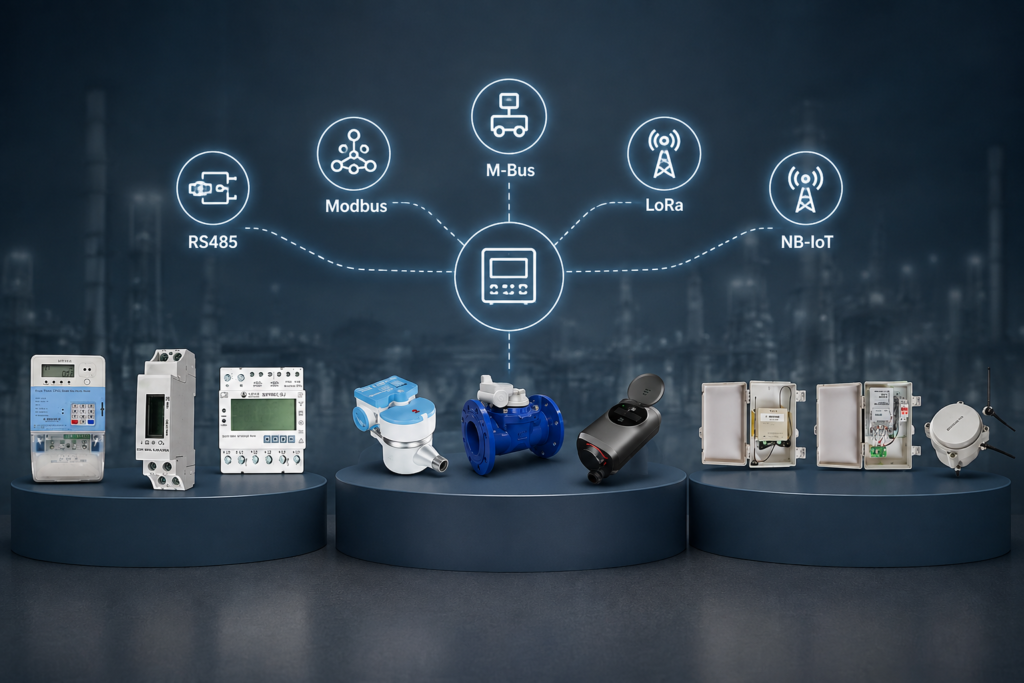
For manufacturers, utility companies, and system integrators, selection of the right communication technology will be challenging. There are options like RS485, Modbus, M-Bus, LoRa, and NB-IoT, which offer different advantages in terms of range, connectivity, installation, scalability, and transmission.
Shenzhen Xingyuan Intelligent Meter offers intelligent metering solutions that are designed to support modern requirements for reliable smart meter connectivity and effective data communication. Knowledge of the differences between these protocols will help businesses select the most suitable for their applications.
What Is Smart Meter Communication?
Smart meter communication refers to the technologies and protocols used to transfer measurement data from the smart meter to different devices, gateways, servers, or utility management platforms. Effective smart meter data communication helps remote meter reading, real-time or periodic monitoring, fault detection, usage analysis, and automated billing.
The modern AMI smart meter communication system will combine with meters, communication networks, data concentrators, gateways, and cloud-based platforms. The right communication protocol is based on factors like the installation environment, distance between devices, required data volume, infrastructure, and operating costs.
Reliable Wired Communication: RS485 Smart Meter
The RS485 Smart Meter is used as the RS485 physical communication standard for transmitting data through a wired connection. RS485 is mainly used in industrial and automation applications since it offers reliable communication, good noise resistance, and the ability to connect to different devices on the same communication bus.
One of the important advantages is its suitability for environments where meters are installed fairly close to one another. It supports multi-point networks; it allows different meters to communicate with the central controller.
RS485 is mainly suitable for apartment buildings, commercial properties, factories, and energy-management systems where wiring infrastructure is available. But RS485 requires physical cabling. The installation will therefore become more difficult and expensive when meters are mainly distributed or located in difficult-to-access areas.
Flexible Data Exchange: Modbus Smart Meter
A Modbus Smart Meter is used for the Modbus communication protocol; it mostly operates over the RS485 physical connection. Modbus is mainly recognised in industrial automation and creating management systems due to its simple architecture and wide compatibility.
Modbus helps smart meters communicate measurement parameters like voltage, current, power, energy usage, and other operating information to a controller or the monitoring platform.
The main benefit of Modbus is interoperability. As many industrial devices already support Modbus, integrating a Modbus-enabled meter into the existing automation system will be relatively direct.
Designed for Utility Metering: M-Bus Smart Meter
The M-Bus smart meter is based on the meter-bus communication standard, which was specifically developed for use in metering applications. M-Bus is commonly found with water, heat, gas, and electricity meters.
Unlike general-purpose industrial communication protocols, M-Bus is mainly designed around the requirements for meter reading. It supports different meters connected to the central master device and is suitable for collecting data from distributed utility meters.
M-Bus will be mainly used for residential buildings, commercial properties, and installations where different meters require monitoring. For projects that involve dedicated utility metering infrastructure, M-Bus will offer an effective and structured approach to meter data collection.
LoRa Smart Meter: Long-Range Wireless Connectivity
The LoRa smart meter is used for Lora-Based wireless communication, which transmits meter data over long distances while maintaining relatively low power consumption. This makes it attractive for applications where running communication cables is difficult or expensive.
LoRa technology will be useful for smart-city projects, water-metering networks, agricultural applications, industrial sites, and large residential developments. Different meters will communicate wirelessly with gateways, which then forward data to the central platform. One of the vital advantages is the deployment flexibility. Wireless communication will reduce the requirement for extensive cabling and will communicate wirelessly with gateways, which then forward data to the central platform.
One of the major advantages is the deployment flexibility. Wireless communication reduces the requirements for extensive cabling and makes it easier to connect meters installed across large areas.
But LoRa networks require suitable gateway infrastructure with proper network planning. Coverage, building materials, and interference with local deployment conditions will be considered before implementation.
Cellular IoT Connectivity: NB-IoT Smart Meter
The NB-IoT Smart Meter uses Narrowband Internet of Things technology to communicate over cellular networks. Different protocols require a dedicated local communication network. NB-IoT will use existing cellular infrastructure, which is supported.
This makes NB-IoT attractive for widely distributed meters. Water, gas, and electricity meters will potentially transmit data to remote platforms without needing to connect to the local gateway at every installation.
NB-IoT is basically useful when long-distance communication, low-power operations and large-scale deployment are vital. It always supports remote meter reading and helps utility operations, which reduces the requirement for manual data collection.
The main considerations will include cellular network availability, subscription or connectivity costs, and are based on the requirements of the chosen IoT platforms.
The Importance of Smart Meter Data Communication
Reliable smart meter data communication is important for turning raw meter readings into useful operational information. A well-designed communication system will enable automated readings that reduce manual labour, improve billing accuracy, identify abnormal consumption, and support energy-efficiency initiatives.
Since utilities and businesses are moving towards digital infrastructure, AMI smart meter communication is becoming increasingly essential. Advanced metering infrastructure will connect meters with head-end systems, data-management platforms, analytics tools, and customer applications. The future of metering is increasingly about more than just measurement accuracy but also about secure, reliable, and scalable communication.
Conclusion
RS485, Modbus, M-Bus, LoRa, and NB-IoT each have a valuable role for modern metering. The best choice depends on the installation conditions, communication distance, infrastructure, scalability, power requirements, and system integration requirements.
From the RS485 smart meter for the wired network to the NB-IoT smart meter for a geographically distributed deployment, selection of the right technology will significantly influence the performance and cost of the metering project.
With intelligent metering solutions and modern communication capabilities, Shenzhen Xingyuan Intelligent Meter will support businesses and utility applications that are looking for dependable smart meter connectivity, effective data collection and scalable AMI smart meter communication.
FAQs
1. What is the difference between RS485 and ModBus smart meters?
RS485 is mainly the physical communication standard, whereas ModBus is the communication protocol. ModBus are commonly used in RS485 as the physical communication layer, which allows the meter to exchange structured data with other devices.
2. When should I choose the M-Bus smart meter?
The M-Bus smart meter is mainly suitable for utility metering applications like water, heat, gas, and electricity, particularly when there are different meters which will need to communicate with the central data-collection systems.
3. Which smart meters are better, LoRA or NB-IoT?
It mainly depends on the application. A LoRA smart meter will be suitable for private, long-range wireless networks that use gateways, whereas an NB-IoT smart meter will have an advantage for widely distributed installations which will use cellular IoT networks.
4. Why is communication important in AMI smart meters?
AMI smart meter communication will enable meters to transfer consumption and operational data automatically. It will support remote meter reading, automated billing, monitoring, analytics, and improved utility management.