











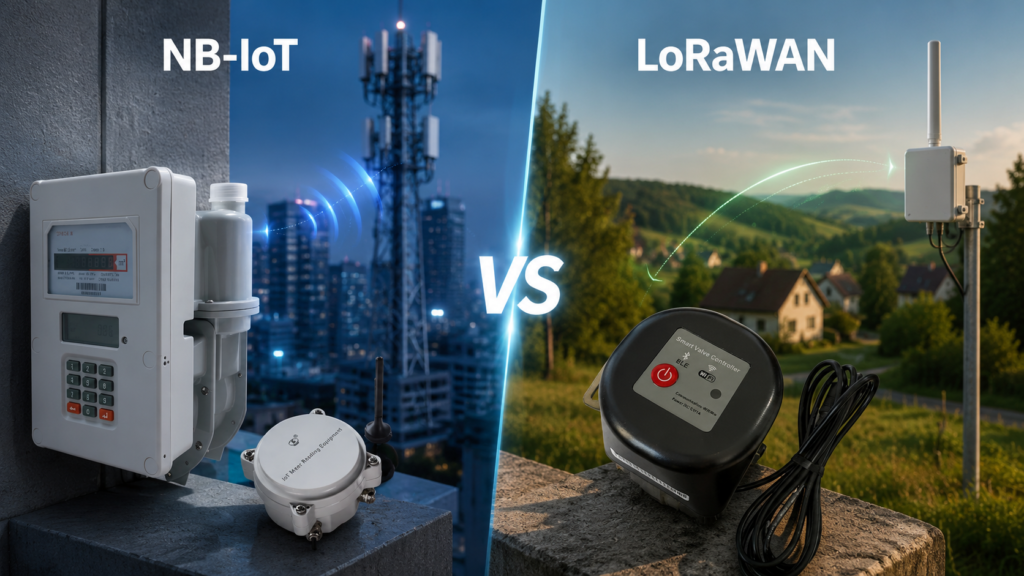
NB-IoT and LoRaWAN are the leading technologies for smart meter connectivity. Both technologies support large numbers of low-data devices over long distances, but they differ in spectrum, ownership, cost and control.
What Is NB-IoT?
Narrowband Internet of Things (NB-IoT is the cellular low-power wide-area technology standardized through 3GPP. It always operates in the licensed spectrum and generally uses infrastructure managed by the mobile network operator. A meter with the NB-IoT module communicates directly with the cellular network, reducing the requirement for utility-owned gateways. When the devices are distributed in large service areas. It will support massive numbers of low-throughput devices, improved indoor coverage, low power consumption, and delay-tolerant applications. Smart metering is the recognized use case. GSMA might require SIM or eSIM provisioning, operator agreements, recurring charges, and reliable carrier coverage. Utilities will also have less control over network changes and future pricing.
What Is LoRaWAN?
LoRaWAN is the open low-power wide-area networking standard optimized for battery-powered devices. It mainly operates in unlicensed regional spectrum and uses a star-of-stars architecture. Meter messages reach one or more gateways, which forward them through IP connections to the central network server. It may create a private LoRaWAN network, use a public network, or choose a managed service. It provides control over the gateway placement, coverage, data routing, and costs. Adaptive data rate will optimize radio settings for individual devices. These will suit electricity, gas, water, and submetering systems which send small packets periodically. Private deployment, however, requires radio planning, gateways, backhaul, maintenance, and capacity management. Planners should also consider regional transmission rules and interference.
NB-IoT vs LoRaWAN: Key Differences
- Coverage: Both technologies will reach difficult locations. NB-IoT benefits from cellular coverage-enhancement techniques, whereas LoRaWAN will achieve strong indoor or underground performance for correctly positioned gateways. Site testing is more reliable than advertised range figures.
- Infrastructure and Network Control: NB-IoT transfers network responsibility to the telecom operator. It reduces infrastructure workload but increases operator dependency.LoRaWAN permits utility-controlled networks, requiring more planning but offering greater freedom to improve local coverage.
- Cost: NB-IoT will reduce gateway investment, but module costs, SIM management, and subscriptions should be calculated across the total meter fleet. LoRaWAN requires gateways and network management, although a private network will avoid per-device cellular fees. For dense local deployments, LoRaWAN might provide a lower total cost of ownership. NB-IoT may be more economical when cellular infrastructure is readily available and creating a private gateway network will be impractical.
- Power Consumption: Both include power-saving mechanisms, but battery life depends on reporting frequency, signal strength, retries, payload size, and firmware design. Efficiency is important for battery-powered water and gas meters. Assumptions will be less critical for grid-powered electricity meters. In these deployments, network availability, data-delivery reliability, and operational simplicity can receive greater priority.
- Data Capacity and Latency: Typical smart metering communication will involve periodic readings, alarms, and device-status messages. Both technologies will handle these workloads. NB-IoT might be more preferable when more frequent communication, licensed-spectrum operation, or cellular services management is important. LoRaWAN works well for scheduled readings and low-throughput telemetry; however, its network capacity needs to be planned carefully for dense meter fleets.
- Security: NB-IoT uses cellular authentication and network security. Lo+RaWAN uses device identities, session Keys, and cryptographic protection for radio transmissions. There are secure IoT connectivity options for smart meters which will also require protected device provisioning, firmware updates, backend access controls, encryption-key management, and continuous monitoring.
Which Technology Is Better?
NB-IoT is basically the stronger choices which depend on the cellular coverage that exists, whether meters are geographically dispersed, whether the utility wants the minimum gateway ownership, and whether recurring operator fees are acceptable. It will simplify regional or national deployment through established mobile infrastructure.
LoRaWAN is frequently better when meters are concentrated in the city, campus, industrial site, housing development, or defined utility area. It is attractive when the organization wants private network control, flexible gateway placements, and less dependence on pre-device subscriptions.
Large smart-metering projects have shown that LoRaWAN will support extensive deployments when the network coverage and capacity are properly engineered. LoRaWAN will connect dense meter clusters, whereas NB-IoT serves remote or isolated locations. It will allow the selection of the connectivity according to the local coverage, meter density, and economics instead of forcing one technology across every installation.
Conclusion
There is no winner in NB-IoT versus LoRaWAN. NB-IoT offers licensed spectrum, established cellular infrastructure, and the operator-managed service model. LoRaWAN provides network-ownership flexibility, customized coverage, and potential lower long-term costs in dense private deployments.
Utilities need to compare meter density, installation environment, message frequency, security responsibilities, service expectations, network ownership, and lifecycle costs before making the decisions.
For dependable smart infrastructure solutions, which are conducted for pilots across representative meter locations is the safer approach. The pilot needs to evaluate coverage, battery performance, message-delivery success, installation requirements, and total operating costs.
FAQs
Which is better: NB-IoT or LoRaWAN electricity meters?
NB-IoT might be better for the widely distributed electricity meters which will use the existing cellular coverage. LoRaWAN might be more economical and controllable for the dense deployment where strategically positioned gateways are practical.
Does LoRaWAN support the AMI meter network?
Yes, it may support scheduled meter readings, alarms, remote configurations, and low-data rate utility communication. Gateway coverage and network capacity need to be planned according to the number of meters and their reporting frequency.
Which technology has the lower smart-meter connectivity costs?
NB-IoT will reduce the infrastructure investment but will involve recurring operator charges. The private LoRaWAN network will require gateway and ongoing management but might reduce long-term per-device connectivity expenses.
Will NB-IoT and LoRaWAN work together?
Yes, the hybrid system will use LoRaWAN for dense local meter clusters and NB-IoT for remote or isolated meters. It is the approach which will improve coverage, flexibility, scalability, and deployment.