










The right water measurements are becoming increasingly vital for industries, commercial facilities, residential development, utilities and municipalities. Since water technology continues to change, organisations should decide whether to use traditional mechanical water meters or upgrade to modern smart water metering solutions.
It is the decison which important in applications which use industrial flow measurements, where the accuracy, reliability, maintenance requirements, and access to real-time data will get dorectly affected in the operating efficiency.
Traditional water meters have served the industry for decades, whereas smart meters have introduced advanced digital monitoring, remote access, and automated reporting. Companies like Shenzhen Xingyuan Intelligent Meter Co., Ltd. have provided modern metering solutions which are designed to support more efficient water monitoring and management.
Understanding the differences between traditional meters and smart meters will help companies to select the right industrial flow meter for their specific requirements.
1. What Are Traditional Water Meters?
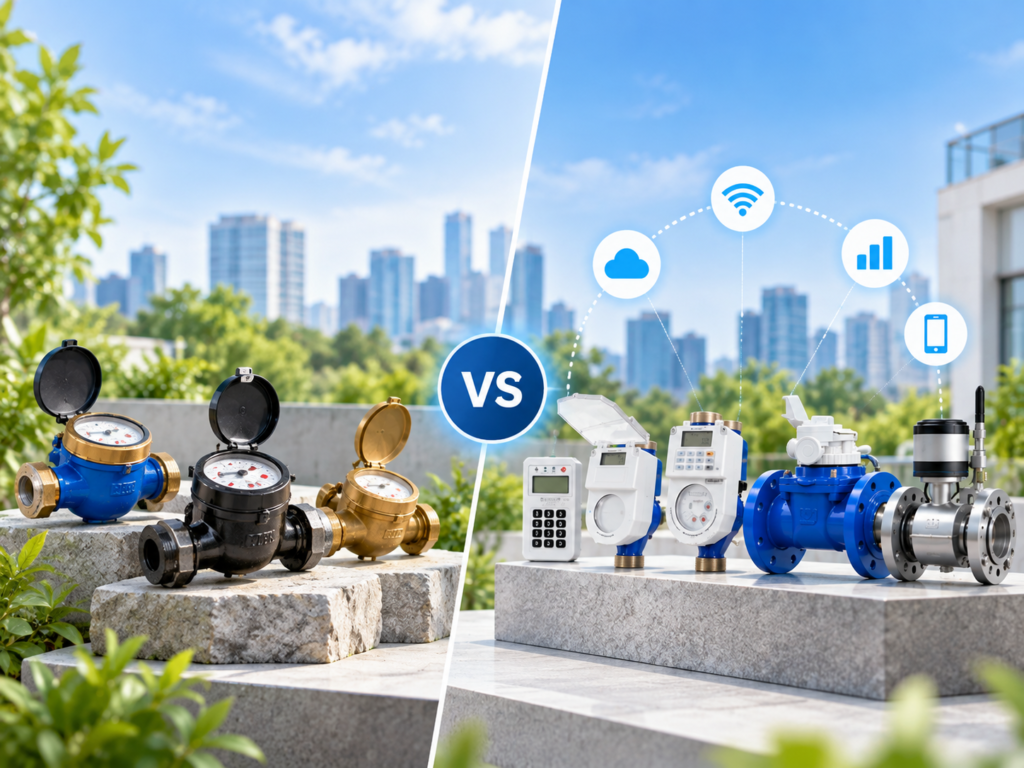
Traditional water meters generally use mechanical devices to measure the amount of water passing through a pipeline. Inside the meter, moving devices like turbines, rotors, or impellers respond to water flow. Their movement is converted into a reading that represents total water consumption.
These meters are widely used in residential, commercial, municipal, and industrial environment since of their relatively simple design.
The main characteristics of traditional water meters include mechanical flow measurements, manual meter reading, basic consumption data, and relatively low initial installation costs.
Moreover, mechanical meters will gradually experience wear as their internal components gets exp[osed for flowing water. Minerals, sediments, and other materials will all affect the performance over time.
For major applications, they will provide a practical solution. However, businesses requiring detailed industrial flow measurement will require more advanced technology.
2. What Are Smart Water Meters?
Smart water meters use electronic measurement technology and communication systems, ms which provide more detailed information about water consumption.
Depending on the design, smart meters will use ultrasonic, electromagnetic, or other digital measurement technologies. Ultrasonic meters are very useful since they can measure water flow without requiring mechanical moving parts inside the measurement chamber. The design will provide improved measurement stability, which reduces mechanical wear.
Modern smart meters will also be integrated into digital flow measurement systems, which allow data to be transmitted to centralised software platforms. Users might be able to monitor usage remotely, analyse flow trends, detect abnormal using paterns, and identify potential leaks.
For industrial facilities and water use management across different locations, this level of visibility will have the significant simplify water management.
3. Accuracy and Measurement Performance
Accuracy is one of the most essential factors while there is the selection of the industrial flow meter. Traditional mechanical meters generally provide reliable measurements under normal operating conditions. Moreover, their accuracy will mainly decline due to mechanical wear, sediment accumulation or changes in internal devices.
Low-flow conditions will also pose challenges for some mechanical designs. Smart water meters, mainly ultrasonic models, will provide high accuracy in a wider range of flow conditions. Since the measurement process will not depend on mechanical movements, performance is less affected by component wear.
Accurate measurements are mainly valuable for billing, industrial processes, building management, utilities, and applications where small differences in consumption will become significant over time.
4. Maintenance and Service Life
Maintenance requirements are one of the major differences between traditional and smart metering technology. Mechanical water meters contain moving components which will gradually require inspection, maintenance, calibration or replacement.
Locations with high mineral content, sediments, or demanding operating conditions will experience additional maintenance requirements. Many smart meters uses non-mecghanical measurements of technologies. With fewer moving components. These generally result in less physical wear inside the meter. Companies have analying different industrial flow meter types will therefore consider not only the purchase price but also long-term maintenance requirements and total operating costs.
5. Data Access and Remote Monitoring
Traditional meters will provide collected consumption values. A technician will be required to visit each meter periodically to record readings.
While the methods will work for smaller installations, it becomes time-consuming to manage large water networks. Smart meters will transmit data automatically through a communication network. It depends on the system configuration; users will access meter information through a centralised dashboard or water management platforms.
There is flow measurement systems will provide information like hourly use, daily use, unusual flow patterns, continuous flow events, and potential leakage conditions.
6. Leak Detection and Water Loss Reduction
Water leakage causes ecological and economic problems. Traditional meters mainly indicated the issuers which has occured when the bill reflected as the unexpected high amount of water use for a certain period.
Smart meters allow detecting irregularities earlier, so that it is possible to minimise water wastage and unnecessary expenses. For example, if the flow rate of water is different at the time when the facility is closed, the system will alert the user.
It is the way, smart industrial flow meters will help industrial facilities, municipalities, hotels, commercial buildings, and residential housing address the issues before they create significant expenses.
7. Cost Considerations
Traditional mechanical meters mainly have a lower initial purchase price. They are therefore appealing for initiatives with tight budgets.. Moreover, the total cost will include additional factors such as manual readings, maintenance, repairs, replacements, and potential measurement inaccuracies.
Smart water meters basically require a higher initial investment since they include digital measurement devices and communication technology. However, potential operational benefits include reduced manual meter-reading costs, lower maintenance requirements, improvement in billing accuracy, remote monitoring, and faster leak detection.
Companies will evaluate lifecycle costs, which will rather than focusing exclusively on purchase prices.
8. Smart Metering for Modern Water Management
Modern water management increasingly depends on the right data. Smart meters will become a part of integrated flow measurement systems, which will allow utilities, factories, properties and commercial organisations to monitor water usage more effectively. The ability to collect detailed water usage data will support operational planning, billing management, preventive maintenance and sustainability programmes.
Shenzhen Xingyuan Intelligent Meter Co., Ltd. is one of the companies which provides intelligent metering solutions which are designed to support modern water measurement applications. The integration of advanced metering technology with digital monitoring capabilities helps companies to gain greater visibility into water usage and improve management efficiency.
Conclusion
Traditional water and smart water meters have important applications. Mechanical meters do remain a practical option for straightforward installation where budgets and basic consumption measurements are mainly considered.
However, smart meters provide significant advantages for organsations which requires advanced industrial flow measurement, remote monitoring, detailed usage data, leak detection, and reduced maintenance.
For businesses, utilities, and industrial facilities, when analysing different industrial flow meter types, factors like accuracy, operating conditions, maintenance requirements, data access, and long-term costs will all be considered.
Digital water management continues to develop smart metering technology, and connected flow measurement systems are becoming valuable tools for improving efficiency, controlling water loss, and supporting sustainable water management.
FAQs
1. What is an industrial flow meter?
An industrial flow meter is a device that measures the flow rate or quantity of liquids or gases. In water-related systems, industrial flow meters are mainly applied in factories, utilities, commercial sites, processing facilities, and water distribution networks.
2. What are the main industrial flow meter types?
The main categories of industrial flow meters are mechanical meters, ultrasonic flow meters, electromagnetic flow meters, turbine meters, vortex meters, and differential-pressure flow meters. Depending on the fluid, pipe size, accuracy, flow range, environment, and application, there are several types of industrial flow meters to choose from.
3. Why are smart meters useful for industrial flow measurement?
Smart meters are beneficial for industrial flow measurement because they enable accurate flow monitoring and analysis with digital data access, remote management, consumption tracking, and abnormal-flow detection. As a result, smart meters can help companies optimise their processes for improved performance and minimise water wastage.
4. What are flow measurement systems?
A flow measurement system includes flow meters, sensors, communication devices, and monitoring systems used in flow monitoring and data analytics. Industrial and utility flow management systems offer remote access, reporting, trending, alarms, and data access.